
Quantum Computer Science Research Group

On the Cover of ‘Annalen der Physik’
Our research, focusing on quantum computers, has been selected as the cover article for the April 2024 issue of Annalen der Physik, one of the oldest and most prestigious journals (published since 1799). In this study, we focused on the design of arithmetic logic processing units based on QFT (quantum Fourier transform). By this means, we proposed for the first time a soft-core processor design that enables the direct execution of classical computer program codes, such as Python programs, on the software-driven processor layer deployed on superconducting quantum computers. This research is also supported by the TÜBİTAK-3501.
Related article: https://doi.org/10.1002/andp.202300457
What is quantum computer?
A quantum computer is a type of computer that operates based on the principles of quantum mechanics. Unlike classical computers, which use bits to represent information as either a 0 or 1, quantum computers use quantum bits or qubits, which can exist in multiple states at the same time. This property, known as superposition, allows quantum computers to perform many calculations simultaneously, leading to exponential speedup over classical computers. Quantum computers have the potential to solve complex problems in fields such as cryptography, drug discovery, and optimization that are infeasible with classical computers. However, building a practical quantum computer is challenging due to the inherent fragility of quantum states, and many technical challenges must be overcome before they can be used for real-world applications. Let’s hear about quantum computers from Prof. Michio Kaku as well.
Quantum Processing Unit (QPU)
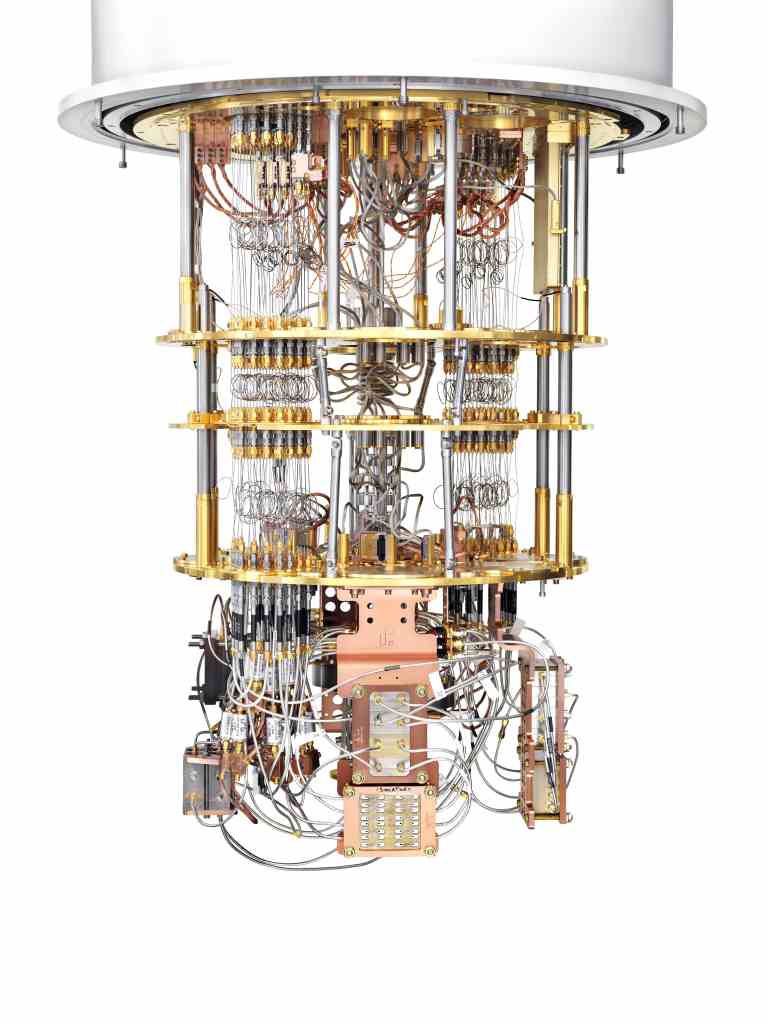
A quantum processing unit (QPU) is a type of computer processor that uses quantum mechanics to perform calculations. Unlike classical computers, which use binary digits or bits to store and manipulate data, a QPU (Fig. 1.) uses quantum bits or qubits. Qubits have the ability to exist in multiple states at once, which allows quantum computers to perform certain types of calculations much faster than classical computers. However, due to the inherent fragility of quantum states, QPUs require specialized cooling and shielding to operate effectively. Additionally, programming a QPU requires a different approach than programming a classical computer, as the algorithms used for quantum computation are fundamentally different from classical algorithms. Despite these challenges, QPUs have the potential to revolutionize fields such as cryptography, optimization, and drug discovery, and many tech companies and research organizations are actively working to develop practical quantum computers using QPUs.
Superconducting Qubit
Transmon qubit is a type of superconducting qubit that has gained popularity in the field of quantum computing due to its simplicity and robustness. It is a type of charge qubit that utilizes a Josephson junction to create a non-linear inductance, which allows it to be operated in a stable manner at higher frequencies than other superconducting qubit types. The transmon qubit (see Fig. 2.) has several desirable properties, such as a longer coherence time, a reduced sensitivity to charge noise, and an improved scalability compared to other superconducting qubit types. These features make it a suitable candidate for building large-scale quantum processors. However, one of the major challenges with transmon qubits is the difficulty in controlling individual qubits, which can limit the scalability of quantum systems. Nonetheless, research in the field of transmon qubits is ongoing, and the development of improved control methods and materials could lead to significant advances in quantum computing.
